WOODWORK AT AEROVISTO
Veneering
The face of your cabin, crafted in wood.
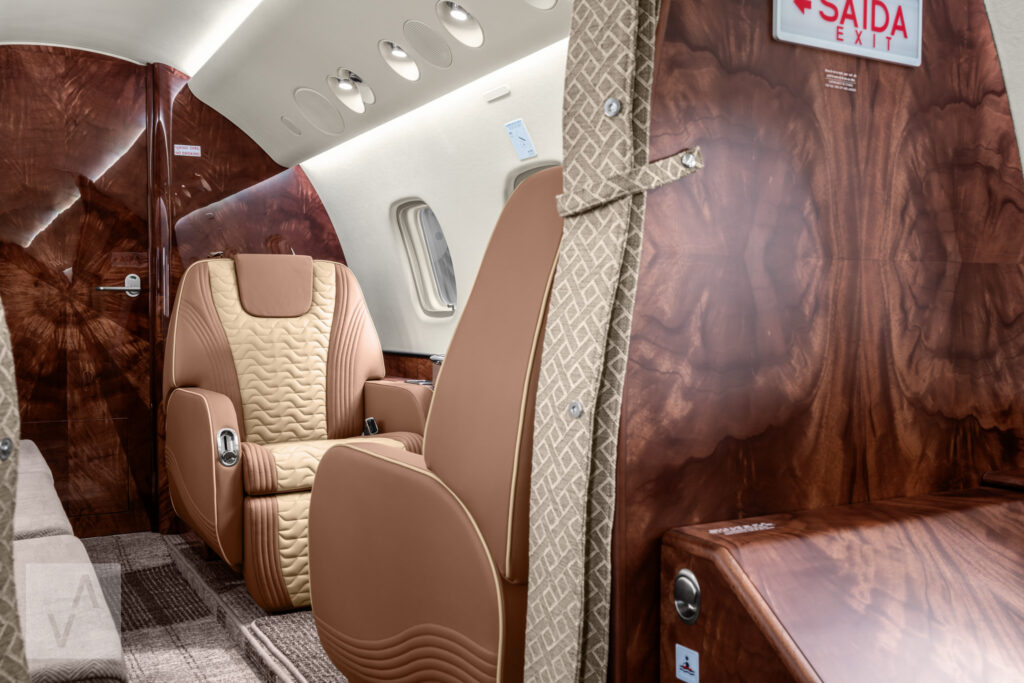
Few elements shape the character of a cabin like its wood. Veneer gives the interior its face — the grain running through monuments, tables, and panels, the warmth that makes long hours at cruising altitude feel grounded.
Behind that face is a craft: wood selection, workmanship, and the experience to know what is possible.
A Design Discipline
Veneering is the craft of giving cabin surfaces a real-wood face: thin leaves cut from a chosen log, bonded to lightweight aviation panels, and finished to last. On paper, it is a standard step in any refurbishment. In practice — done well — it is closer to an art form.
Every project starts with your vision. The AeroVisto team assesses the aircraft, listens to what you want the cabin to feel like, and recommends woods, cuts, and compositions to match. The foundation of a great result is laid in these first conversations, long before the first leaf of veneer is cut.
Thinner Than You Think
The veneer in an aircraft cabin is remarkably thin — typically 0.4 to 0.8 millimeters, often around 0.6. It is not structure; it is the visible design surface, bonded to a lightweight sandwich panel and protected by the varnish build-up above it.
Veneer, adhesive, panel, and finish form one defined, certified material build-up. Changing any layer affects weight, stability, and fire testing — which is why AeroVisto assesses the complete build-up in every project, not only the surface you see.
A typical cabin monument, from the outside in:
- Aviation-grade varnish — the visible, protective surface: sheen, depth, and resistance.
- Real-wood veneer — a few tenths of a millimeter; the wood picture itself.
- Certified adhesive — bonds the veneer permanently to the panel.
- Outer skin — often glass-fiber composite; carries the surface loads.
- Honeycomb core — lightweight meta-aramid honeycomb; stiffness at minimal weight.
- Rear skin — closes the sandwich panel.
Panels measure roughly 10 to 15 millimeters or more, depending on their role. At hinges, fittings, and mechanisms, local reinforcements carry the loads. The complete build-up — not any single layer — is what gets certified.
The Wood: Variety and Choice
No two logs are alike. Every species carries its own character, and choosing veneer means choosing the mood of the cabin. Clients at AeroVisto choose the exact piece of wood, not a picture in a catalog.
| Species | Appearance | Effect in the cabin |
|---|---|---|
| Walnut | warm brown, straight grain, sometimes with lively figure | classic, settled warmth |
| Maple — incl. tiger and bird's-eye | pale cream; figured cuts show waves or small “eyes” | light, bright, modern |
| Cherry | fine, even grain, warm reddish brown; deepens with light and age | traditional, mellow |
| Oak — incl. pippy and bog oak | pronounced grain; pale to deep gray-brown | structured, architectural |
| Sycamore / harewood | very pale and fine; can be dyed silver-gray | light elegance — or cool, contemporary calm |
| Anigre | pale golden brown with a soft glow | quiet, refined warmth |
| Tamo ash | swirling, almost cloud-like figure | distinctive, decorative |
| Eucalyptus, figured | reddish brown with rich figure | warm, expressive |
| Wenge | near-black with fine dark lines | contemporary, dramatic |
| Macassar ebony | striped, high-contrast dark wood | a bold statement |
| Koa | golden to red-brown, often with flame figure | rare, exotic warmth |
| Burl veneers — walnut, madrona, amboyna | dense, swirling figure | luxurious focal surfaces |
Every species behaves differently under tinting and finishing, and some classic woods are trade-restricted or simply rare today. Advice on the right choice — including engineered veneers with consistent grain and color — is part of every veneering project at AeroVisto.
How far can the choice go? For example, for the interior refurbishment of an Embraer Legacy 650, AeroVisto sourced an extremely rare Mahogany Crotch Snowflake veneer. The pattern only exists where two trees have grown together, as twins, from a single trunk. The cabin was measured in detail, and each section of the slab was placed where its figure would matter most. Rare taste is a sourcing question — not a limit.
Design Without Limits
The look you may know from your yacht or your home — matte natural surfaces, light or deep dark schemes — can be brought into the cabin. What it needs is translation into materials and build-ups that meet fire-safety standards, hold the aircraft’s weight budget, and endure years at altitude. That translation is our work at AeroVisto.
Cabin design keeps evolving. Current directions include matte, open-pore surfaces that keep the wood tactile; both light and dark color schemes; engineered veneers where consistent grain matters; and hand-crafted details such as inlays and contrast borders. AeroVisto follows these developments closely and discusses them regularly with interior designers — so every client sees the newest options before deciding.
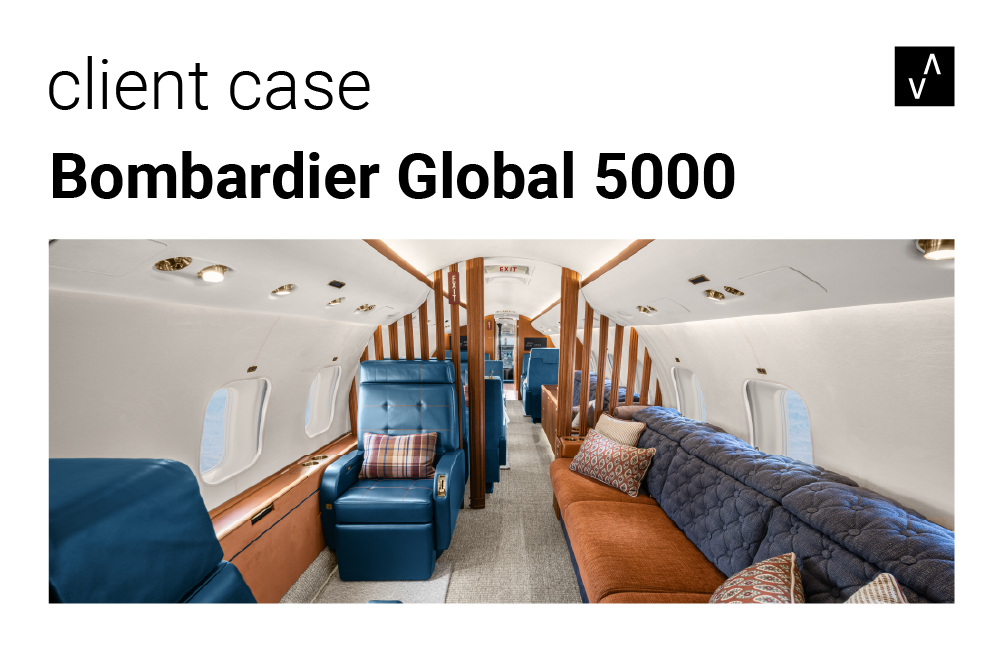
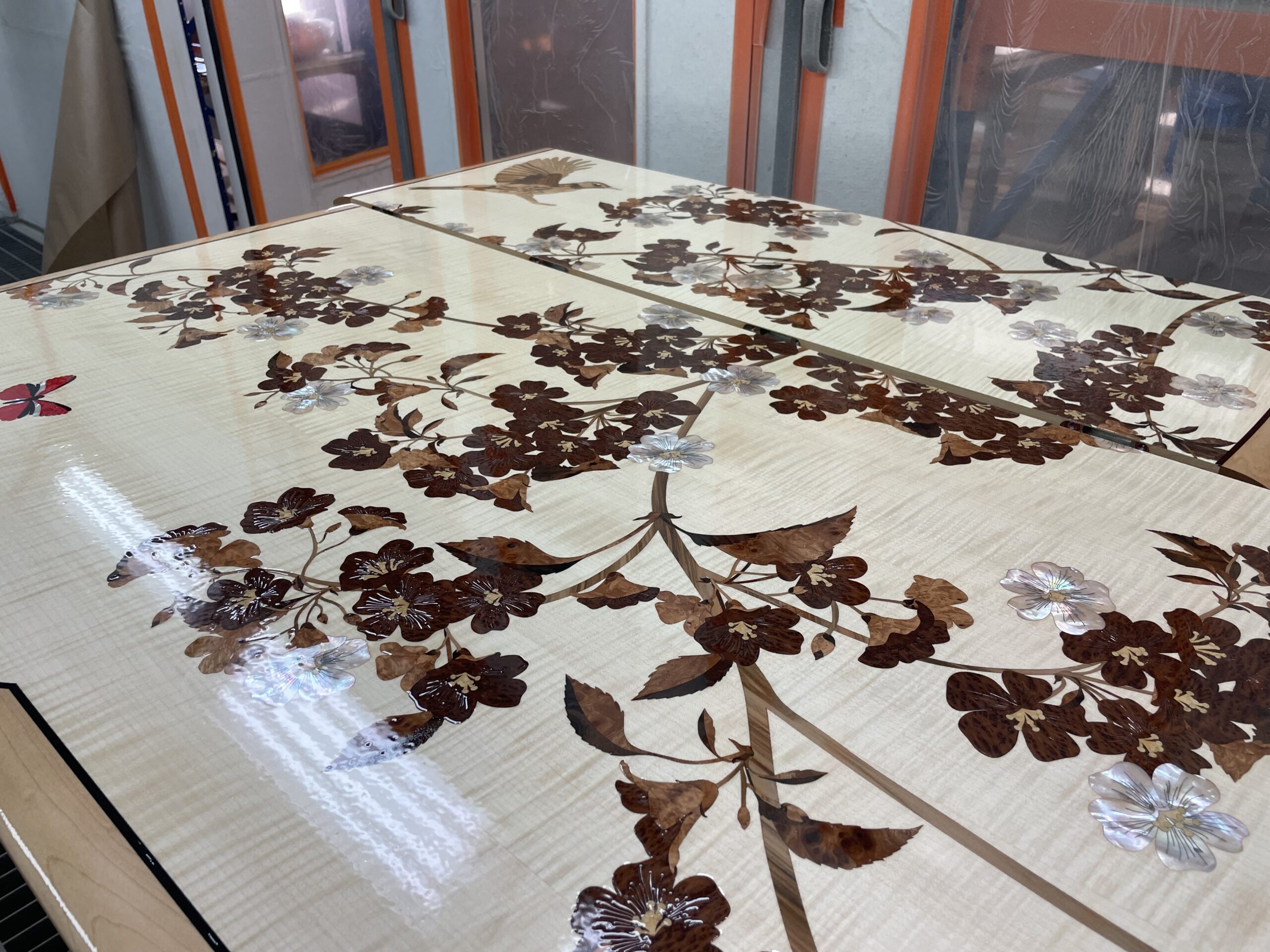
Two of our client cases show the range: A Bombardier Global 5000 was finished in beautiful open-pore, smooth-to-the-touch wood. And for a Bombardier Global Express XRS, AeroVisto integrated hand-crafted marquetry — geometric and floral inlays on tables and credenza tops — coordinated internationally and certified for flight.
Signature Concepts: From Two-Tone to Piano Black
Strong wood concepts are often built on contrast. One current example, realized on a Bombardier Global 5000: deeply tinted surfaces framed by light hardwood edges — a dark field, a light border — repeated on every monument, every pull-out table, every panel frame. The result reads as deliberate, crafted quality, visible from the first step into the cabin.
Contrast also works in the details. Inlays, borders, and two-tone pairings give a cabin identity without changing its architecture — small surfaces, carefully composed, that reward a second look.
The most demanding concept is piano black: veneer brought to a mirror finish. In veneering terms, it is a question of the wood — selecting and preparing veneer for a surface that will read like black glass. The finishing process behind that mirror is covered on the Varnishing & Revarnishing page.
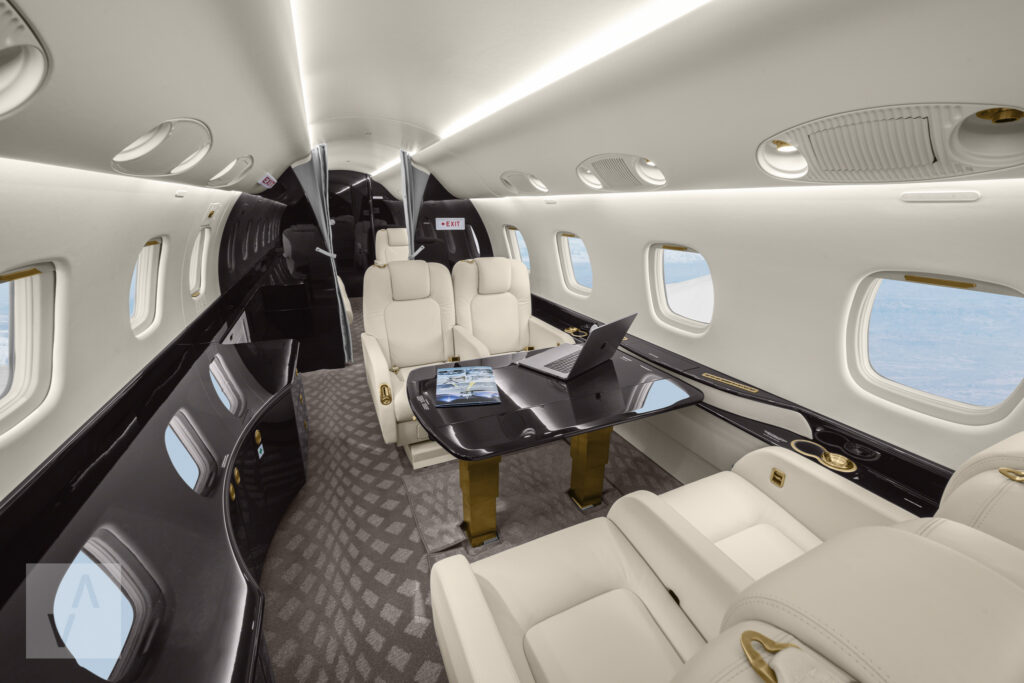
When New Veneer Is Not Needed
The condition of the existing wood decides the path. Veneer that is intact can often be tinted and revarnished instead of replaced. For example, for a Bombardier Global 5000, the existing veneer was tinted to a precise dark matte tone; only the surfaces that could not carry the new design received new wood. All renewal paths, from careful preservation to full re-veneering, are compared on the Varnishing & Revarnishing page.
Thorough Planning, Comprehensive Support
Woodwork is one of the most important decisions in a refurbishment, and AeroVisto plans it accordingly. You choose from physical samples — real wood, in your hands. Scope, milestones, and installation are laid out before work begins and aligned with your schedule and existing maintenance windows — so the project runs the way it was planned. From first consultation to final installation, AeroVisto stays responsible. That is what comprehensive support means here: one partner, all the way through.
Certification and Documentation: What Lands in Your Records
Every material that enters your cabin — every veneer, every layer of varnish — is tested and certified to FAR 25.853 and CS 25.853, the fire-safety standard that governs aircraft interiors. That is not the interesting part.
The interesting part is what you hold in your hands afterward: an Engineering Order, an EASA Form 1, a complete documentation trail filed in your aircraft records. Years later — at an audit, a CAMO review, or the pre-buy inspection that decides your aircraft’s next chapter — those documents answer every question before it is asked. Beautiful woodwork is what your passengers see. Airworthy woodwork is what your records prove.
The framework behind it: AeroVisto holds EASA Part 145 and Part 21G approvals, along with UK CAA certification.
The Other Half of Woodwork
The veneer is one half of woodwork. How it is protected — how it keeps its depth, its color, and its airworthiness through years of flying — is the other.
Related: Decor Film Application
Varnished veneer is one way to a wood surface — decor film is another, and AeroVisto masters both as disciplines in their own right. Which solution serves which surface is a design decision, made together with you.
Questions We Hear Often
The range covers classic and rare species, from walnut and maple to figured and burl veneers. You choose from physical samples, and for partial work the AeroVisto team matches new veneer to the existing cabin by species, grain direction, and tone before any surface is finalized.
Partial work is common and legitimate. The craft lies in making it invisible: matching species, cut, and tone so renewed surfaces age consistently with the rest of the cabin. Where matching would remain visible, this is addressed openly before work begins.
Re-veneering replaces the wood picture itself; revarnishing renews the protective finish on the veneer you already have. Which one your cabin needs depends on the condition of the wood beneath — a survey often shows the veneer is sound and the finish is the real issue. Both paths are compared honestly on the Varnishing & Revarnishing page.
Veneer build-ups in aviation are engineered thin and light, and every combination of veneer, adhesive, and finish is tested as one system to FAR/CS 25.853 before it flies. Weight and compliance are design inputs from day one.
Cabin veneer is typically 0.4 to 0.8 millimeters thick, often around 0.6. Beneath it sits a lightweight sandwich panel — outer skin, honeycomb core, rear skin — joined by certified adhesives and protected by the varnish build-up on top. All layers together form one certified system, and AeroVisto assesses that system as a whole in every project.
Every project is delivered with its paperwork: Engineering Order, EASA Form 1, and the flammability documentation for the installed materials. Everything is filed in your aircraft records, ready for the next audit or pre-buy inspection.
Proven On Board
Embraer Legacy 650 — an extremely rare Mahogany Crotch Snowflake veneer, placed piece by piece through the cabin.

Bombardier Global Express XRS — hand-crafted marquetry on tables and credenza tops: functional art, certified for flight.

Bombardier Global 5000 — existing veneer preserved and tinted to a precise dark matte tone: a new character without new wood.