
Aircraft Refurbishment as a Business Model
A conversation with Hermann Bauer, Managing Director of AeroVisto Group.
You hear it more and more often in business aviation: operators building their fleet on pre-owned aircraft — bought used, brought up to standard, refurbished, and put into charter at rates that match far newer equipment. It sounds almost too simple. So we asked the man whose teams carry out these projects how the calculation actually works.

Hermann, operators keep telling the market that their business is built on refurbished pre-owned aircraft. Do you hear this in your shops as well?
“We have been living it for years — these are our clients. And the important thing to understand is what these operators are actually doing. More and more decide to buy aircraft on the market, deliberately. Aircraft that are ten to fifteen years old. Next, they bring them to an excellent technical standard, have the exterior repainted, and refurbish the interior to be state of the art — modifying it if connectivity or other systems need upgrading.”
So refurbishment after someone buys a used aircraft means a repair with a bigger scope.
“Then I have explained it badly. When thinking of aircraft refurbishment as part of a business model, nothing happens after. The refurbishment is in the business plan before the aircraft is even bought — as a fixed component, calculated like everything else in the project. Only this way does the whole model work out at the end. Refurbishment costs are planned investments. This is a different world from “let’s get started and see what comes up” projects.”
Then walk me through that planning process.
“Let me explain it the way these clients explain it to me, because they do this very precisely.
Before anything is bought, operators know what they can charge — for a seat, for a flight. They know the market prices for used aircraft. They know which aircraft type they want, and they have analyzed that carefully: which routes they want to serve, what their clientele expects, how many passengers they typically carry. Then they buy the aircraft, at a considerably lower price than a new one, and collect their quotes — maintenance, exterior, interior.”
And AeroVisto is one of the quotes.
“We are — although the quote is usually not where our work begins. The earlier we are involved, the better. We advise on what is possible, we look at the aircraft together, we help our clients capture everything that matters before the big decisions are made. That way, realistic costs are on the table from the start.
Then comes the number. I am careful with the word “fixed,” because projects can change — and when something changes, the price changes with it, openly. What we offer is a price our clients can count on. You have to see this from their side: if refurbishment is a line in a business plan, a number that quietly grows is of no use to anyone. They tell us what the cabin should become, we quote it, and they can build their calculation on that figure.
That is also why I do not see us as one quote among several. Helping to make the calculation realistic is part of the work — and it starts long before the price.”

What is the attraction of refurbishment as a business model?
“The heart of the model is a calculation that looks simple at first glance. You buy an aircraft at a fraction of the capital cost of a new one. You invest — technology, exterior, interior. And when everything is done, you are still well below the price of a new aircraft, while achieving the same charter rate, the same seat price, as if you had bought new. At the same time, you have created a unique, individual asset — an aircraft with a modern, beautiful cabin, clearly recognizable on the market.
And the gap this model works with is public information. A new aircraft delivered at close to fifty million dollars can be listed, ten years on, at well below a third of that price. Any broker platform will show it.”
So, if the cabin appearance matters that much, why don’t operators simply buy new and specify exactly the interior they want? The manufacturers offer that.
“For a single aircraft, they can. For a fleet, it does not work — especially when that fleet is meant to be diverse.
Operators usually choose their aircraft by route. For one route an Embraer Legacy makes sense, for another a Global, for a third an XLS — or even a Pilatus. In other words: operators deliberately pick the optimal equipment for each mission, and that equipment comes from different manufacturers. Now try to make all of those look alike — to gain design consistency across your fleet — by ordering each one new from its OEM. I think you would go crazy, and you probably would not get there at all. Why? Because every manufacturer has its own approvals — what one has certified, the other has not. So how do you gain consistency across several OEMs?”
I would guess that is not easy.
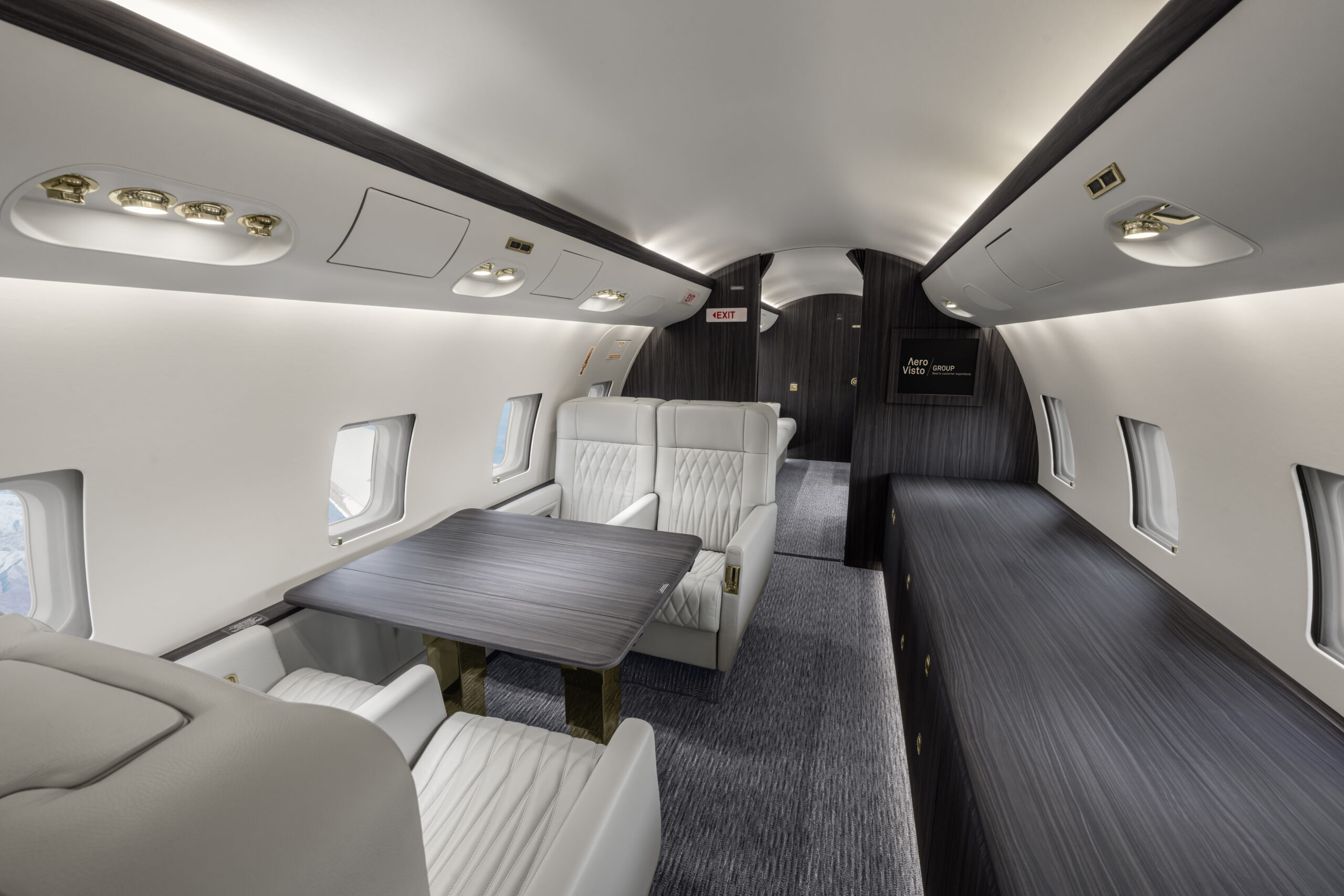
“Not from the factory, realistically — there it becomes very hard. A consistent, individual design across a fleet from different manufacturers, with different materials and different suppliers, runs into far fewer obstacles in the aftermarket. So that is what operators do: they select the most suitable aircraft from different OEMs, and then they apply their own brand identity, their own design language, across the entire fleet. That is the right approach, and our clients understand it very well.”
“Brand them” — what exactly are we talking about?
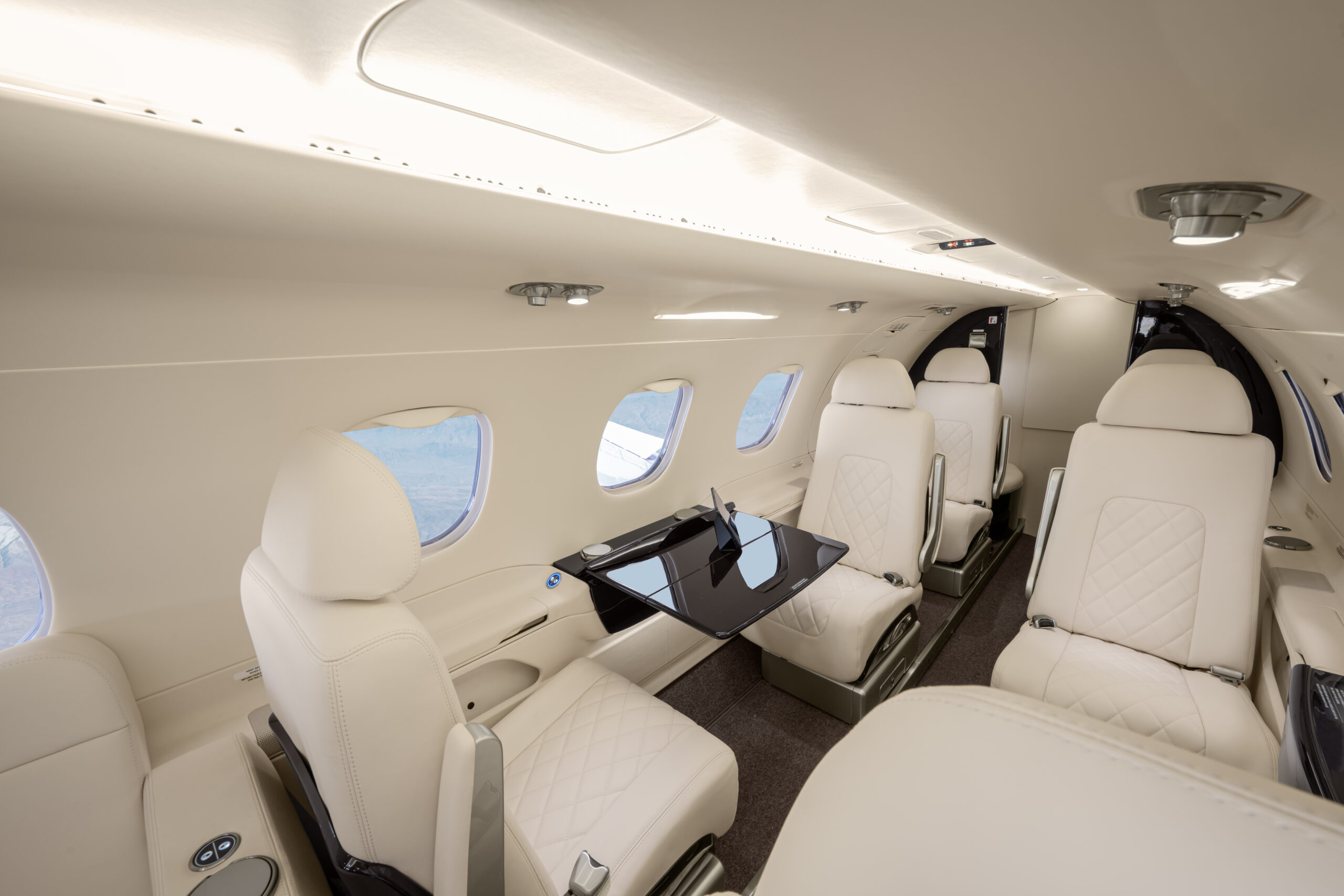
“We are talking about how recognition works: details. The same stitching on the seats. The same headliner, the same materials, the same carpet. In short: the same overall impression the moment the door opens. Every aircraft these operators buy looks different, inside and out. After our work, a passenger steps on board and knows immediately: this is my favorite charter company. The recognition is in the details — and that recognition is a strategy our clients base their business on. And we are the ones who make it repeatable.”
On which aircraft types does this model make the most sense?
There is no fixed rule. That is something every operator has to decide for themselves. They know which routes they want to serve and what their clientele will board — some clients will not step into a small aircraft, others need range, others need seats. This, too, has to be thought through carefully and reflected in the business plan. But that is not our call at AeroVisto. What I can tell you from our side: we work across the types. The principle is the same on all of them.
What happens when operators grow?
“They usually do — that is what a business model like this is built for. So yes, more aircraft come in, or even more aircraft types. And this is why refurbishment, as part of the business model, has to be planned for repetition from the first aircraft on: the same specification, reproduced on the next aircraft and the one after that, whatever type it happens to be.
It also means the refurbishment partner has to be able to grow with the operator — in skills, in capacity, in processes, in communication. That is the reason we put so much value on developing every part of AeroVisto, the craft side as much as the administrative side. The market does not stand still. Neither do we.”
Let’s get concrete: when an operator arrives with the first aircraft, what does AeroVisto actually do?
“Quite a lot of listening, at the beginning. We want to understand the business concept before we talk about the cabin: what the operator plans, which clientele, which expectations. Then it becomes concrete: we advise on materials, we develop the design, we produce renderings, we make proposals for what the cabin can look like — until the picture matches what our client wants to sell to their own customers.
And behind all of that sits the real task: connecting things. Engineering, design, certification, economics — and the experience of the passenger who will eventually sit in that cabin. We also think about the operation itself: a charter cabin has to survive daily use, and someone will have to clean it, care for it and repair it for years. So maintainability is part of the conversation from the very beginning. When all of that fits together, the first aircraft becomes the template for the fleet.”
All of this is effort the passenger never sees. How much of it does he notice in the end?
“Ideally, nothing.
One of our clients told us recently that stepping into his aircraft — an aircraft that has been flying for more than a decade — felt like the day he collected it new from the factory. The cabin looks the way it looked when it left the production line. The exterior works the same way: a freshly painted aircraft does not show its age. And technically the aircraft has to be in perfect condition anyway. Put the three together — cabin, exterior, technology — and what the passenger experiences is a new aircraft.”
One last question, then. In this whole model — what is AeroVisto?
“AeroVisto is not simply a service provider. We are the right partner for making refurbishment as a business model work.
Of course, the craftsmanship has to be excellent and the certifications have to be in place — that is the foundation, and our clients can expect it from us. But our actual job goes further: we help them succeed with their concept. The model works when the cabin delivers — on price, on schedule, and on the experience their own customers pay for. That is the standard we hold ourselves to. On the first aircraft, and on every one that follows.”